Tamiya Gray Fine Surface Primer L, 180ml Spray Can Review (2026)
Updated September 21, 2026 · Research-based review
Our verdict
Tamiya's Gray Fine Surface Primer L in a 180ml spray can lays down a very fine, light gray coat that bites into plastic and reveals seams and scratches before paint goes on. It suits modelers who want a detail-preserving lacquer primer for scale kits, though the 180ml can is on the small side for priming whole armies of miniatures.
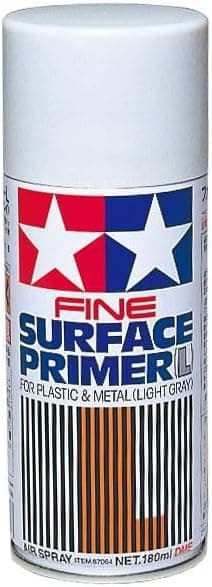
Tamiya Gray Fine Surface Primer L in a 180ml spray can, a very fine primer that reveals flaws before painting.
Price range: See on Amazon
What we liked
- + Very fine spray preserves tiny sculpted detail
- + Gray tone shows seams and scratches that need fixing
- + Lacquer primer bonds strongly to plastic and resin
Trade-offs
- - 180ml can is small for priming whole armies
- - Solvent primer has strong fumes, so ventilation matters
What this primer is built for
Tamiya's Fine Surface Primer L is a lacquer-based spray primer in light gray, sold in a 180ml aerosol can, formulated to prepare plastic model parts made of ABS and polystyrene for paint. Tamiya also lists it as usable on metal parts, giving it some reach beyond pure plastic kits into resin or metal detail parts on the same build. The primer is described as fine, meaning its pigment particles are small enough to bite into the surface and fill tiny scratches or imperfections without burying sculpted detail under a thick layer. The L in the product name distinguishes this larger can from Tamiya's smaller spray primer bottles sold for touch-up work.
Why builders use it before paint
Beyond giving paint something consistent to grip, this primer's light gray tone is specifically useful for spotting flaws: sink marks, seam lines, and small sanding scratches that are hard to see on bare plastic become much more visible once a uniform gray coat is applied. That makes it a diagnostic step as much as a preparation step, letting a builder catch and fix surface issues before committing to a final paint job rather than discovering them partway through painting. Tamiya notes the primer can also be wet sanded once dry, letting a builder smooth out the surface further after the initial coat if needed, then reprime the sanded area before moving on to color coats.
Lacquer formula considerations
Because this is a lacquer-based primer rather than a water-based acrylic, it bonds aggressively to plastic and dries hard, which is part of why it fills small imperfections well, but it also means it carries solvent fumes that are stronger than an acrylic spray primer's. Builders need to use it in a well-ventilated space, ideally outdoors or with a spray booth, rather than in an unventilated room. The upside of the solvent-based formula is a strong, durable bond to styrene and ABS plastic that some builders find more reliable for handling and further sanding than acrylic primers offer.
Can size versus project scale
At 180ml, this can is smaller than some rival spray primers sized at 400ml or larger, which matters for anyone priming a large batch of tabletop miniatures or an entire army rather than a handful of scale model kits. For scale modelers working on individual car, aircraft, or armor kits, 180ml goes a reasonably long way since a single kit uses far less surface area than a squad of miniatures. Builders planning to prime many small models regularly may find themselves replacing this can more often than they would a larger-format primer from another brand, so it is worth weighing project volume before settling on this can size specifically.
Bottom line
This is a precise, detail-preserving primer well suited to scale modelers who want a light gray base that highlights surface flaws before final paint, backed by Tamiya's reputation for consistent lacquer-based sprays. The main trade-offs are the stronger solvent fumes typical of a lacquer formula, which call for good ventilation, and a smaller 180ml can size that suits individual kits better than bulk miniature priming. For plastic and metal scale model parts specifically, it remains a dependable choice for catching flaws early and giving paint a strong surface to hold onto.
Frequently asked questions
What materials can this primer be used on?
Tamiya lists it as suitable for ABS and polystyrene plastic, and it can also be used on metal parts.
Is this a water-based or solvent-based primer?
It is a lacquer-based, solvent primer, so it should be used in a well-ventilated space rather than an enclosed room.
Can this primer be sanded after it dries?
Yes, Tamiya notes it can be wet sanded once dry to smooth the surface further before painting.
Is the 180ml can enough to prime a large batch of miniatures?
It works well for individual scale model kits, but a larger-format primer may be more economical for priming many miniatures at once.
Prices change often, so check the current price and availability on Amazon.
Check price on AmazonMini Paint Lab may earn a commission from the link above.