Vallejo - Airbrush Flow Improver for Acrylic Paints 60 ml (2.02 fl.oz.) Review (2026)
Updated September 21, 2026 · Research-based review
Our verdict
Vallejo's Airbrush Flow Improver suits painters already fighting tip dry and clogging with acrylic airbrush paints, adding a small dosed amount to slow needle drying and smooth spray. In a 60ml bottle a little goes a long way, but it is a flow aid, not a thinner, so most setups still need one too.
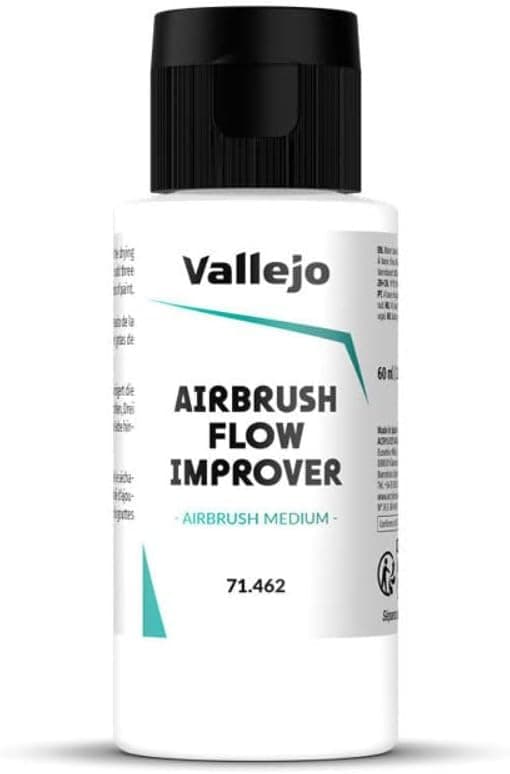
Vallejo Airbrush Flow Improver for acrylic paints in 60 ml (2.02 fl.oz.), an additive that slows drying at the nozzle.
Price range: See on Amazon
What we liked
- + Slows paint drying so the airbrush tip clogs less often
- + Improves flow for smoother gradients and fine lines
- + Small doses mean a 60 ml bottle goes a long way
Trade-offs
- - Too much flow improver can leave a tacky or slow-drying finish
- - An additive, not a thinner, so you may still need both
What this additive is for
Vallejo's Airbrush Flow Improver is formulated to be mixed into acrylic paint before airbrushing, with the specific job of delaying how quickly paint dries at the airbrush needle and tip. That drying at the tip, often called tip dry, is one of the most common causes of speckling, sputtering, and clogging during an airbrush session, since dried paint flakes can spit onto the model or block the nozzle entirely. Vallejo states the formula works with its Model Air, Game Air, and Metal Color paints, and the product is sold in this 60ml (2.02 fl.oz.) bottle size, alongside larger bottle options for painters who go through it faster in a busy studio setup.
How it is meant to be used
The recommended approach is to add it in small ratio to the paint already in the airbrush cup, roughly one to two drops of Flow Improver for every ten drops of paint, rather than replacing a meaningful portion of the paint volume. Because the effective dose is so small, a 60ml bottle covers a large number of airbrushing sessions before running out, which is part of why painters who thin paint by the drop find it economical despite the bottle looking small next to a 200ml paint jar. It is meant to be added alongside the paint's normal thinning routine, not instead of it, and small test batches on scrap plastic help confirm the ratio before committing to a full model.
What it does not replace
Vallejo is explicit that this product is not intended to thin paint to a sprayable consistency and does not reduce pigment particle size, meaning it will not turn thick, unthinned paint into something ready for an airbrush on its own. A painter still needs a dedicated thinner, or pre-thinned airbrush-ready paint such as Model Air, to get the base viscosity right before flow improver is added. Skipping that step and relying on flow improver alone to fix spray consistency is a common point of confusion for newer airbrush users, and it will not solve viscosity problems by itself.
Where it earns its keep
For painters who already have their thinning ratio dialed in but still fight tip dry during longer sessions, especially with fine detail work at low pressure where the airbrush sits closer to the surface and dries out faster, this additive smooths out spray consistency and reduces interruptions from clogging. It is most useful on quick-drying acrylics that build up at the tip and on gradient or fine-line work where any interruption to spray shows immediately on the model. Painters doing only occasional, broad-coverage airbrushing with well-thinned paint may notice less benefit, since tip dry is less of an issue at higher flow rates and shorter sessions with fewer pauses between passes.
Bottom line
This is a targeted fix for a specific airbrushing problem, tip dry and clogging, rather than a general-purpose thinner, and it works best as a small addition alongside whatever thinning method a painter already uses with Vallejo's Model Air, Game Air, or Metal Color ranges. The 60ml bottle is sized generously relative to how little product each session actually uses, so cost per use stays low over many painting sessions. Painters who have not yet nailed down their base thinning ratio should sort that out first, since flow improver supplements a working setup rather than fixing an unthinned one from scratch.
Frequently asked questions
How much flow improver should I add to my paint?
Vallejo's general guidance is roughly one to two drops of flow improver for every ten drops of paint in the airbrush cup.
Can this replace airbrush thinner?
No, it is not intended to thin paint to a sprayable consistency; it is an additive used alongside a thinner or pre-thinned airbrush paint.
What paints is it compatible with?
Vallejo lists it as compatible with its Model Air, Game Air, and Metal Color paint ranges.
What problem does flow improver actually solve?
It slows paint drying at the airbrush needle and tip, which reduces the speckling and clogging caused by tip dry during spraying.
Prices change often, so check the current price and availability on Amazon.
Check price on AmazonMini Paint Lab may earn a commission from the link above.